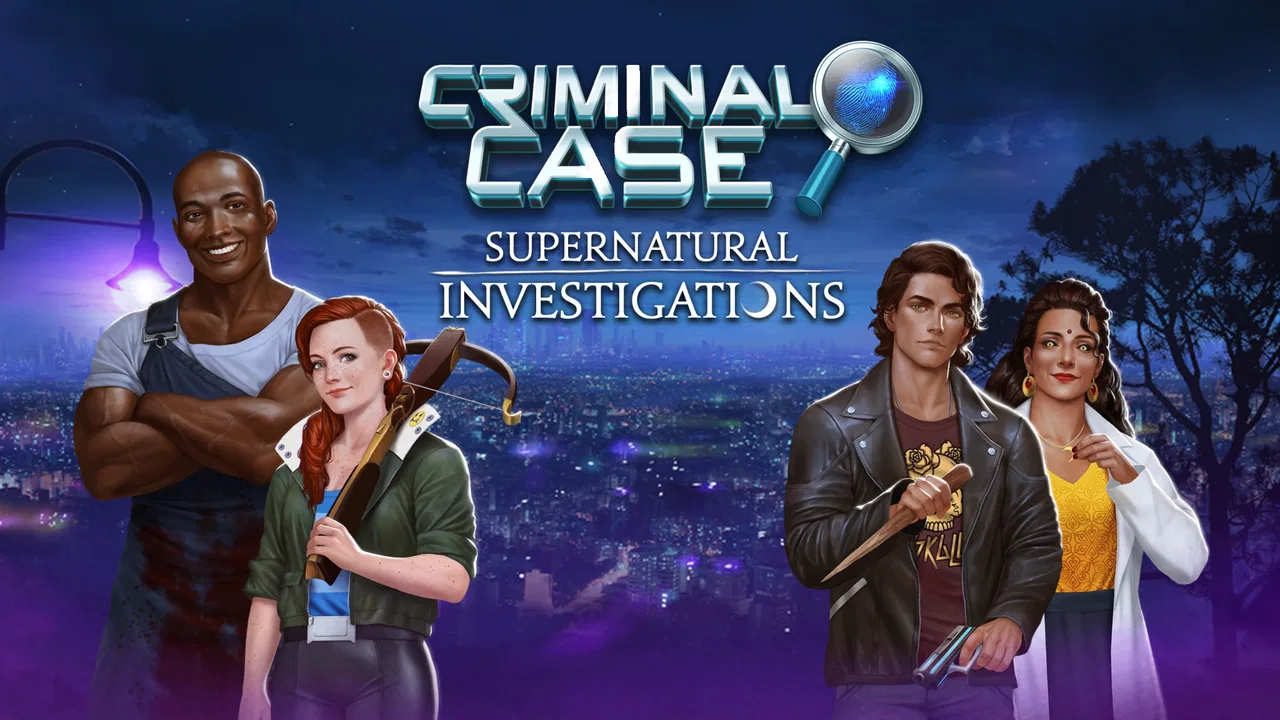
Criminal Case: Supernatural
- 4.7
- Rating
- 1.00M
- Installs
- Free
- Price

 Analysis by App-foxy
I went into Criminal Case: Supernatural expecting a familiar hidden-object adventure with a darker theme, and that is exactly where its appeal lies. It turns murder investigations into short, approachable play sessions: I examine scenes, look for clues, follow the case story, and decide whether the supernatural setting is enough to keep me coming back. It is not trying to be a complex detective simulator. Instead, it is a casual investigation game from Pretty Simple that works best when I want a little mystery without having to learn a complicated control system.
The important question is not simply whether the game is free or popular. The better question is what kind of investigation experience you want. If you enjoy searching busy scenes, moving through a serialized case, and repeating familiar actions while gradually uncovering a story, this is an easy game to recommend. If you want unrestricted exploration, demanding deductions, or a mystery where every conclusion depends on your own reasoning, I would point you toward a different kind of adventure.
What I consider before recommending it
My first decision point is the pace. This game is built around compact activities rather than long uninterrupted investigations. That makes it suitable for a quick break, a commute, or a few minutes before bed. It also means the experience can feel repetitive if I play for a long stretch. The same basic rhythm—inspect a location, find objects, gather evidence, and continue the case—can be relaxing at first but less satisfying when I expect constant mechanical variety.
You May Also Like

 Blood Strike: 2.5 Anniversary
Blood Strike’s Loadouts Turn Every Drop Into a Tactical Gamble
A close look at Blood Strike’s custom loadouts: how fast access to signature weapons reshapes its battle royale rhythm, rewards preparation, and narrows the gap between fights.

 Pandora - Music & Podcasts
Pandora’s Music Is Easy to Start, but Harder to Recover
Pandora’s strength is its low-effort path from a seed to a station. Its weak spot is how much confidence it asks you to place in connection, setup, and quiet recovery.

 8 Ball Pool
 Is Built on Rivalries, Rematches, and Routine
A close look at the rivalries, rematches, shared routines, and unanswered safety questions that turn a quick pool match into a persistent mobile community.

 Samsung Music
’s Quiet Strength Is Playing What You Already Own
Its reach comes less from spectacle than from dependable access to a personal library. That simplicity is both the app’s strongest retention engine and its ceiling.

 AccuWeather: Weather Radar
AccuWeather Review: A Quick, Clear Forecast for Everyday Decisions
For everyday plans, the best forecast is the one you can understand quickly. AccuWeather makes rain timing, radar, and local conditions easy to act on, with a few trade-offs.

 Hill Climb Racing
Why Hill Climb Racing Still Turns Crashes Into One More Run
A tiny car, a bumpy hill and one more upgrade: Hill Climb Racing keeps resurfacing because its simple chaos makes every near-miss feel personal.
More From Our News Desk



The second point is how much control I want over the detective work. The game gives me a clear path through its cases, so I am not left wondering what to do next. That accessibility is useful for casual players, but it reduces the sense of solving a completely open mystery. I am usually searching for items and following the investigation’s structure rather than building a case from independent theories. For me, that makes it closer to a story-led hidden-object game than to a traditional point-and-click detective adventure.
The supernatural theme also matters. A conventional crime game may focus on realistic motives, evidence, and police procedure. Here, the atmosphere leans into unusual cases and paranormal ideas. I find that gives the setting a distinct identity, especially when I want something more imaginative than an ordinary police investigation. However, players who prefer grounded crime fiction may find the tone less convincing or less emotionally serious than they expect.
Finally, I look at how the free structure affects the experience. The game costs nothing to start, but it includes optional purchases ranging from $0.99 to $99.99 per item. That wide range is worth remembering before playing. I can try the main experience without paying, yet anyone who dislikes purchase prompts or progression systems influenced by spending should approach it cautiously. The right mindset is to treat it as a casual free game, not as a premium mystery bought once and owned without interruptions.
How the investigation loop feels in everyday play
A realistic use case is a short evening session after work. I can open a case, search a crime scene, collect enough progress to move the story forward, and stop without needing to remember a complicated set of controls. That makes the game more convenient than many exploration-heavy adventures, which often ask me to commit a longer block of time or remember several objectives.
There is also a practical advantage to its visual search format: I can play with sound turned down and still understand the basic action. That suits public places or quiet rooms where audio is inconvenient. The trade-off is that the atmosphere may lose some of its impact, because supernatural stories benefit from mood, music, and dramatic presentation. I see it as a game that travels well, but not necessarily one that delivers its strongest impression in every setting.
One useful habit is to slow down when examining a crowded scene instead of tapping randomly. Searching methodically helps me notice objects more reliably and keeps the activity from becoming a frantic guessing exercise. I also prefer treating each location as a visual puzzle rather than rushing through it for the reward. That small change makes the core mechanic feel more deliberate, even though the overall structure remains straightforward.
Where the supernatural setting gives it an edge
The strongest reason to choose this game is its combination of crime investigation and paranormal storytelling. Many casual hidden-object games use historical, romantic, or fantasy settings, while many crime games aim for realism. This one occupies a more specific middle ground. I get the recognizable motivation of solving a murder case, but the surrounding world can move beyond ordinary police work.
That blend makes the game particularly suitable for players who enjoy television-style episodic mysteries. Each case can feel like a small chapter rather than one enormous investigation. I like being able to return to the game after a break and quickly understand the immediate objective. The structure does not demand that I maintain a detailed mental map of a large open world.
The clear presentation is another advantage for people who are new to this genre. I do not need prior experience with detective games, and the basic interaction is easy to understand. The Teen content rating signals that the subject matter is aimed at older children and adults rather than very young players. Even so, the murder-focused premise means parents should consider whether that theme suits the person using the device.
Pretty Simple has also made a game that is easy to sample. It has surpassed one million installs, and its average rating is 4.7 from around 36 thousand ratings, with roughly 2.1 thousand written reviews. Those figures do not guarantee that I will enjoy the pacing, but they do suggest that the format has found a substantial audience. I interpret that popularity as evidence that the accessible investigation loop works for many casual players, not as proof that it replaces deeper mystery games.
Small techniques that make the core loop better
My first practical tip is to separate observation from tapping. I scan the whole scene once, identify unusual shapes or objects, and only then begin selecting items. This is more effective than repeatedly tapping around the screen, especially when the location contains several visually similar details. It also makes the hidden-object portion feel less like a speed test and more like investigation.
My second tip is to play in short, intentional sessions. The game’s repeated structure is at its best when I use it as a break rather than as a marathon. A short session preserves the satisfaction of finding clues and advancing the story. Longer sessions expose the limited variety of the central interaction more quickly, so I would not choose this as my main game for an entire afternoon.
My third tip is to judge the story and the mechanics separately. I may enjoy the supernatural case narrative even when a particular search scene feels routine. Conversely, I may appreciate the easy controls while finding the story too light for my taste. Keeping those two parts distinct helps me decide whether a disappointing moment comes from the plot, the search activity, or the free-to-play pacing.
Where another type of game may fit better
If my priority is unrestricted detective reasoning, I would choose a narrative adventure with more dialogue choices, environmental interaction, and consequences based on evidence. This game guides me through its cases, which is convenient but not the same as independently constructing a solution. Someone who wants to interrogate suspects in depth, compare competing theories, or revisit clues in a flexible order may feel constrained here.
If I mainly want a pure hidden-object experience, a quieter puzzle game might also be a better match. The supernatural crime framing adds personality, but it can bring story interruptions and case progression when I would rather focus only on visual searches. In that situation, a dedicated object-finding game could feel more direct.
On the other hand, players who dislike hidden-object mechanics should probably skip this one even if the premise sounds appealing. The murder investigation theme does not transform the fundamental activity into a complex logic puzzle. Much of the hands-on play still depends on spotting and selecting items. The story can make that loop more meaningful, but it does not remove the loop.
Players seeking a paid, interruption-free experience should also compare it with premium adventure games. The free entry is a genuine advantage, especially when I am unsure whether the supernatural tone will suit me. The downside is that optional purchases and the game’s progression model may feel less comfortable than paying once for a complete title. I would choose this game for accessibility and convenience, not for the cleanest possible business model.
What the free model means for a new player
I recommend starting without spending anything and paying attention to how the pacing feels over several sessions. The game is free, so there is little reason to purchase immediately. First I would decide whether I enjoy the case structure, the visual searching, and the supernatural tone. If those three elements work together for me, an occasional purchase may feel reasonable; if the basic loop already feels repetitive, spending more is unlikely to solve the underlying problem.
The listed purchase range is broad, from $0.99 to $99.99 per item. That does not mean every player will need to buy anything, but it does mean I would keep a clear personal limit before beginning. A simple rule is to treat purchases as optional convenience rather than as a requirement for understanding the story. That approach protects the main benefit of the game—easy access—without allowing the free structure to dictate how I play.
This is also where the cost of switching to another game becomes relevant. Moving from this title to a premium mystery may require an upfront payment, but the reward could be a more focused narrative and fewer free-to-play interruptions. Moving to another casual hidden-object game may preserve the same relaxed pace while changing the theme. I would switch when the specific supernatural investigation no longer compensates for the repeated search scenes, not merely because another game has a different visual style.
Compatibility, maturity, and practical expectations
The game was released on October 5, 2020, and the current version is 2.45.1. It supports devices running Android 7.0 or later, so I would check the operating system before trying to install it on an older phone or tablet. Those details matter most for players using an aging device, because a game that looks suitable can still be unavailable if the operating system is below the requirement.
The Teen rating is consistent with the murder-investigation premise and supernatural subject matter. I would not hand it to a young child simply because the interaction is easy. The accessible controls and colorful presentation can make it look harmless, but the central theme still revolves around crime cases. For teenagers and adults who enjoy fictional mysteries, the rating should be a useful guide rather than a warning that the game is designed for very young audiences.
I would also set expectations about the role of skill. Success here is less about mastering complex controls and more about attention, patience, and willingness to follow the case flow. That is good news for players who want a low-pressure adventure. It is less appealing for anyone who needs deep strategy, fast reflexes, or a strong sense of personal authorship over the investigation.
My recommendation for different kinds of players
I recommend Criminal Case: Supernatural to someone who wants a casual adventure with murder cases, visual searches, and a paranormal flavor. It is especially suitable for short sessions, mobile play without complicated controls, and players who enjoy episodic stories that provide a clear next step. The free starting point makes it easy to test, while the established audience suggests that its formula has lasting appeal for many people.
I would not recommend it as the first choice for a player who wants realistic detective work, open-ended deductions, or a premium experience without optional spending. Those needs point toward a different category of adventure. I would also hesitate to recommend it to someone who becomes frustrated by repeated scene searches, because the central mechanic remains consistent throughout the experience.
For me, the final decision comes down to the balance between theme and repetition. The supernatural crime setting gives the game a recognizable identity, and the short-session format makes it convenient. The cost is that the investigation is guided and the main activity can become familiar. If that trade-off sounds acceptable, I think it is worth installing and trying at no cost. If I need every clue to support a personal theory or every scene to introduce a new kind of challenge, I would save my time for a deeper detective adventure instead.
My honest verdict is therefore positive but specific: this is a good choice for casual mystery fans, not a universal replacement for every adventure game. I would begin with a patient, no-spending trial, use short sessions, and decide based on whether the supernatural cases keep the familiar search loop enjoyable. When those two parts work together, the game is an easy companion for spare moments. When they do not, switching to a more open detective story or a dedicated puzzle game will be the better decision.
FAQs for Criminal Case: Supernatural
01What is Criminal Case: Supernatural about?
Criminal Case: Supernatural is a hidden-object investigation game in which you join a police team handling mysterious cases with paranormal elements. You investigate crime scenes, search for clues, question suspects, analyze evidence, and gradually uncover the story behind each incident. It combines classic detective work with supernatural themes, making it suitable for players who enjoy casual mystery games and episodic storytelling.
02Is Criminal Case: Supernatural free to download and play?
The game is generally free to download and offers a substantial amount of content without requiring an upfront purchase. However, it includes optional in-app purchases that can provide extra energy, faster progress, or other useful resources. You can play without spending money, but the energy system may require patience between investigations, particularly if you prefer playing for long sessions.
03Does Criminal Case: Supernatural require an internet connection?
An internet connection may be needed for downloading the game, synchronizing progress, displaying advertisements, accessing certain features, and receiving updates. Some portions may appear to work temporarily offline, but the experience is designed around online connectivity. If you are traveling or have limited data, it is best to launch and update the game over Wi-Fi before beginning a longer investigation.
04Is the game appropriate for children?
Criminal Case: Supernatural has a cartoon-style presentation, but its central themes involve murders, crime scenes, suspects, autopsies, and paranormal events. The visuals are not designed as realistic horror, yet some scenes and story details may still be unsettling for younger players. Parents should review the game’s content and in-app purchase settings before allowing children to play.
05How does the energy and progression system work?
Investigating scenes, performing actions, and completing certain activities usually consumes energy. Once your energy is depleted, you may need to wait for it to regenerate, watch optional advertisements, use available rewards, or make an in-app purchase. Progress also depends on finding objects accurately and completing case-related tasks, so careful searching and regular play help you advance efficiently without spending money.
Pros
- Engaging hidden-object investigations with varied supernatural cases.
- Distinctive paranormal setting gives the familiar formula extra personality.
- Short case segments make it easy to play during quick breaks.
- Frequent clues and objectives provide clear progress throughout each case.
- Large cast of quirky characters adds humor and memorable interactions.
Cons
- Energy limits can interrupt play when you want to continue investigating.
- Some clues and actions may require premium currency or extra waiting.
- Repeated searches can feel predictable after extended play sessions.
- The storyline occasionally takes a back seat to resource management.
- Small visual details may be difficult to spot on compact phone screens.

Criminal Case: Supernatural
Gallery